When Arrangements Speak Louder Than Apologies: The Rise of Botanical Accountability in the American Workplace
There is a particular discomfort that settles over an office after a professional misstep. Emails become measured. Hallway exchanges grow brief. The invisible architecture of a team—its trust, its rhythm, its shared sense of purpose—quietly fractures. Words, however carefully chosen, often fail to reach the depth of that fracture. Increasingly, a growing cohort of design-conscious American professionals is turning to an unexpected medium to fill that silence: botanical design.
Not the gas-station bouquet hastily assembled as a peace offering. Not the anonymous mixed arrangement dispatched without intention. What is emerging in progressive American workplaces is something far more considered—a deliberate, compositionally sophisticated use of living botanicals to communicate accountability, signal genuine transformation, and restore the emotional equilibrium of a professional environment.
The Limits of the Verbal Apology
Workplace culture consultants have long observed that verbal apologies, while necessary, are rarely sufficient on their own. "Words in a professional setting carry the weight of expectation and performance," explains one organizational psychologist who advises Fortune 500 companies on team dynamics. "People hear an apology and immediately begin evaluating its sincerity. But an object—particularly a living one—operates on a different register entirely. It exists in the space. It continues to communicate long after the conversation has ended."
This is where botanical design enters with quiet authority. A well-composed arrangement is not merely decorative. It is, in the language of design theory, a curated statement—one that can be calibrated to express specific emotional and relational intentions. The choice of flower, the selection of vessel, the balance of negative space, the palette: each element contributes to a message that unfolds gradually, without demand or pressure on the recipient.
Designing Accountability: Beyond the Generic Bouquet
The distinction between a transactional floral gesture and a genuinely accountable botanical composition lies almost entirely in intentionality. Corporate interior designers who specialize in biophilic workplace environments note that this intentionality must begin before a single stem is selected.
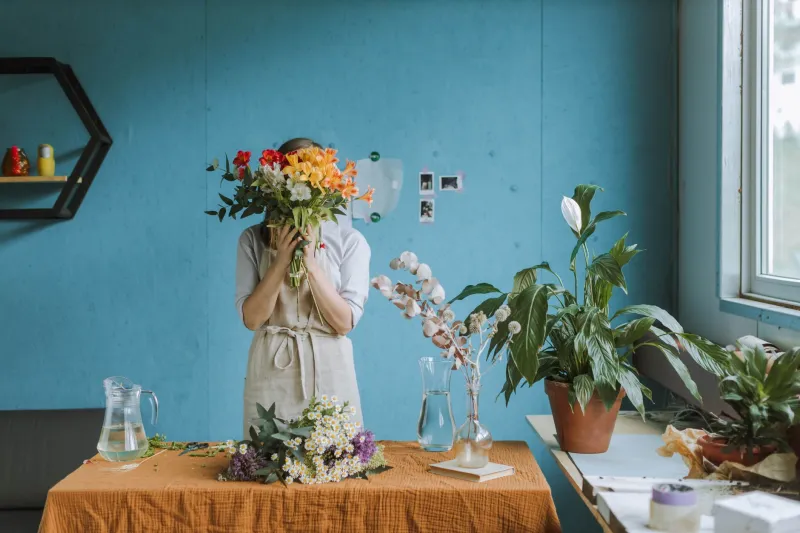
"The first question I ask a client who wants to use botanicals to address a workplace rupture is: what do you actually want to communicate?" says one New York-based designer whose portfolio includes several prominent financial and media firms. "Are you expressing remorse? Commitment to a different approach? Gratitude for someone's patience? Each of those calls for an entirely different composition."
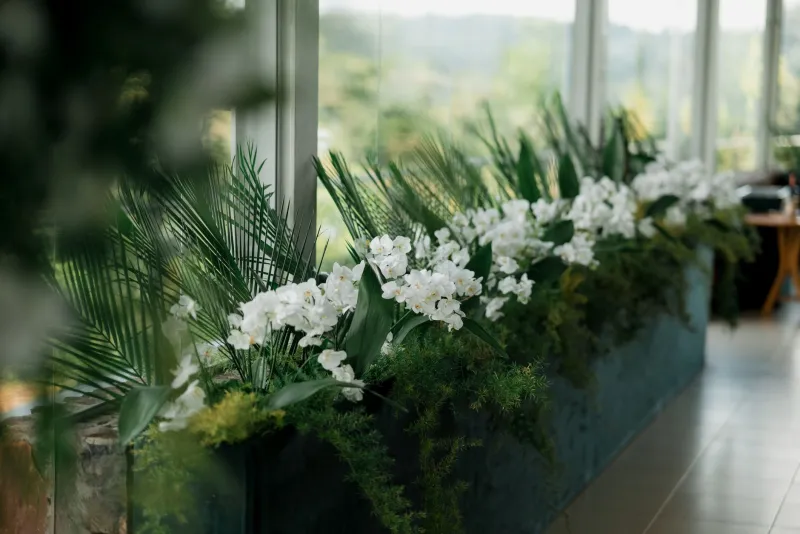
For expressions of sincere remorse, designers frequently reach for arrangements built around white and soft green palettes—hellebores, garden roses in ivory, and trailing eucalyptus—compositions that read as humble and undemanding. The absence of bold color is itself a statement: this is not a performance. For arrangements intended to signal forward momentum and renewed commitment, warmer botanical elements—branches of flowering quince, ranunculus in amber and coral, or sculptural protea—introduce vitality without aggression.
The vessel matters as much as the bloom. A sleek, unadorned ceramic in matte stone tones communicates seriousness and restraint. A weathered terracotta pot suggests groundedness and authenticity. These are not arbitrary aesthetic choices; they are the grammar of a visual language that the recipient reads, often unconsciously, with considerable accuracy.
The Psychology of Living Botanicals in Professional Space
What makes living botanicals particularly potent as instruments of workplace repair—as opposed to, say, a handwritten note or a gift card—is their temporal dimension. They grow. They shift. They require tending. And, inevitably, they fade.
This lifecycle carries profound psychological resonance in a professional context. "A living arrangement placed on someone's desk after a difficult moment says something that a static object cannot," notes a workplace wellness consultant who has worked with technology companies across the Pacific Northwest. "It says: I am investing in something that asks for care. I am choosing to participate in something living, not just offering a finished product and walking away."
Research on biophilic design consistently demonstrates that the presence of living plants in workplace environments reduces cortisol levels, lowers perceived stress, and increases feelings of psychological safety among employees. When a botanical arrangement is introduced into a fractured professional dynamic, it does not simply gesture toward repair—it actively begins to alter the emotional chemistry of the space in which that repair must occur.
A New Protocol for Design-Conscious Professionals
What is perhaps most striking about this emerging practice is the degree to which it reflects a broader shift in how design-literate Americans understand the relationship between their physical environments and their interpersonal lives. The same professional who commissions a biophilic installation for a client presentation is now applying that same design intelligence to the more intimate terrain of workplace relationships.
Some corporate interior designers are formalizing this into a genuine consultation service. Rather than simply selecting botanicals for aesthetic coherence, they are working alongside HR professionals and leadership coaches to develop what one Chicago-based designer calls "relational compositions"—arrangements specifically engineered to support a stated interpersonal or organizational goal.
"We have done work for companies where a senior leader wanted to acknowledge a team that had been asked to carry an unfair burden during a difficult quarter," she explains. "That is not a sorry bouquet. That is a piece of design that needs to say: I see your effort, I honor your sacrifice, and I am committed to a different structure going forward. The botanical choices, the scale, the placement in the shared space—all of it has to carry that message."
Placement as Statement
Where an arrangement is placed within a workplace environment is as communicative as what it contains. A composition delivered to an individual's private workspace signals personal acknowledgment. One placed in a shared conference room or collaborative area speaks to the collective. A botanical installation introduced into a leadership suite communicates a top-down commitment to cultural change.
Designers note that placement also affects longevity of impact. An arrangement that occupies a communal space will be encountered repeatedly by multiple team members, extending its message across days and weeks. It becomes, in effect, a standing reminder of the intention behind it—a living document of accountability that does not require re-reading.
The Arrangement as Ongoing Commitment
Perhaps the most sophisticated practitioners of this approach understand that a single botanical gesture, however beautifully composed, is only a beginning. The most meaningful use of floral design in professional repair is iterative: a series of compositions over time that collectively demonstrate not a momentary impulse but a sustained commitment to a different way of operating.
In this sense, the botanical apology transcends the transactional entirely. It becomes a design practice—a recurring, evolving conversation conducted in the language of living things. For the design-conscious professional, this is not sentimentality. It is strategy, executed with artistry and grounded in genuine accountability.
The American workplace has long been a space where emotional intelligence and aesthetic intelligence rarely share the same vocabulary. Botanical design, at its most intentional, offers a rare bridge between the two—and in doing so, suggests that the most powerful apologies may not be spoken at all.