The Hidden Armature: Why Structure, Not Stems, Decides Whether an Arrangement Holds
Photo: Internet Archive Book Images, No restrictions, via Wikimedia Commons
The Part of the Arrangement Nobody Photographs
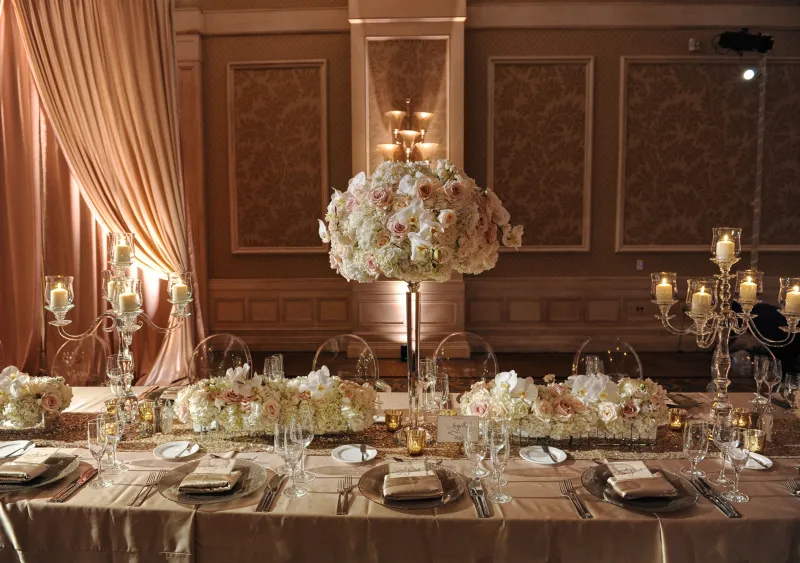
A guest at a benefit dinner sees a centerpiece that appears to have occurred rather than been built. What the guest does not see is the lattice of wire, the crumpled netting, the pin frog bolted to the floor of a bronze urn, or the fist-sized knot of sphagnum holding a nine-pound branch at precisely forty degrees. The visible arrangement is the last ten percent of the work. The rest is engineering, and it happens before a single stem is cut to length.
That engineering has a history, and that history is now in dispute.
The Green Block That Raised a Generation
Phenolic floral foam entered the American trade in the mid-twentieth century and solved a genuine problem. It held stems at fixed angles, carried its own water, weighed almost nothing, and cost pennies. A designer with a brick of foam and a knife could build volume fast, and in a market that rewarded speed and scale, foam became the default substrate of the industry.
It is worth stating plainly: foam was not a shortcut invented by the lazy. It was a tool that made professional results accessible to a far larger group of designers than the old mechanics allowed. The critique of foam that has gathered force over the past decade is not a critique of the people who used it. It is a reconsideration of what the tool costs once it is used as the only tool.
What the Block Actually Does — and Does Not Do
Foam's virtues are real and specific. It immobilizes stems in three dimensions. It permits a designer to place a bloom in midair with no visible support. It holds a reservoir of water in vessels that would otherwise be too shallow. It is, in the hands of a skilled designer, fast.
Its limitations are equally specific, and they are the reason so many studios are quietly changing course.
Hydration. Foam holds water, but it does not circulate it. The reservoir inside a saturated brick becomes stagnant within a day; there is no oxygen exchange, and bacteria colonize the block quickly. Stems are inserted through a cut face into a dense matrix that can abrade and crush the xylem at the point of entry. A rose placed in fresh water will often outlast the same rose placed in foam. This is not a matter of opinion; it is a matter of how the stem takes up water.
Stability. Foam is rigid until it is not. As the block degrades under load, large arrangements can fail suddenly — a branch that has been leaning for six hours gives way at hour seven. Designers who work at scale learn to distrust foam precisely where they need it most.
Cost and labor. A brick costs a few dollars; a properly constructed wire-and-moss armature can cost thirty. Foam wins on the invoice and on the clock. Wire, netting, and pin frogs take longer to build and require a knowledge base that is not taught in most short courses.
Skill. Here is the uncomfortable arithmetic. Foam absorbs the burden of structural thinking. A designer who works exclusively in foam does not have to answer the question that defines the craft: how does this object stand up?
The Old Mechanics, Reconsidered
What is returning to American studios is not nostalgia. It is a set of solutions that happen to work better for certain problems.
- Chicken wire, crumpled and wedged. Poultry netting compressed into a vessel creates a reusable grid that grips stems without crushing them and permits clean water to circulate. It costs almost nothing and can be washed and used for years.
- Pin frogs and kenzans. Heavy, stable, and honest about their presence, they hold branches at the angle the designer chooses and can be anchored with floral putty to the base of a shallow vessel.
- Moss armatures. Sphagnum wired over a frame creates a mass that holds moisture, supports heavy material, and reads as living structure rather than hidden plastic. It is the backbone of the large-scale work now appearing in American galleries, hotels, and private residences.
- Branch scaffolding within the vessel. A few clean limbs cut to wedge against the interior walls will hold an entire arrangement without a gram of foam. It is one of the oldest tricks in the trade and one of the least taught.
- Grid tape and nested vessels. A simple tape lattice across the mouth of a vase, or a smaller vessel set inside a larger one, solves most of the problems foam is brought in to fix.
None of these methods is a moral position. Each is a trade-off in time, money, stability, and water quality. What they share is that they require the designer to think in three dimensions before touching a flower.
Engineering Before the First Stem
Ask a designer who works this way what the first step of a centerpiece is, and the answer is rarely about color. It is about load. Where is the weight? Where is the center of gravity? Is the vessel heavy enough to resist a leaning branch? Will the arrangement be moved after it is built, and if so, how does it come apart? Does the water sit below the mechanics, or does the moss wick it up and away from the stems?
These are carpentry questions asked of flowers, and they shape the finished object more than any palette does. A well-built arrangement looks inevitable. That appearance of inevitability is the reward for an hour of work no one will ever see.
What the Client Is Actually Buying
When a client commissions a large arrangement and is quoted a figure that includes a mechanic they will never notice, the invoice is being honest about something the photograph cannot show. The vessel, the armature, and the conditioning hours are what keep the work standing through a six-hour reception, what keeps the blooms opening rather than collapsing, and what allows the piece to be dismantled in the morning with the vessel intact and reusable.
The flowers are the visible expense. The structure is the invisible one, and it is usually the better investment.
A Quiet Standard
Tierra Floral Design does not treat the choice of mechanics as an ideological test. Some jobs call for a block; most of ours no longer do. What we ask of every arrangement is simply this: that it be built deliberately, with a clear understanding of what is holding it up and what that choice costs in water, time, and longevity. The guest will never see the answer. The flowers will tell them anyway.