Where Six Hundred Dollars Goes: A Line-by-Line Look Inside a Centerpiece
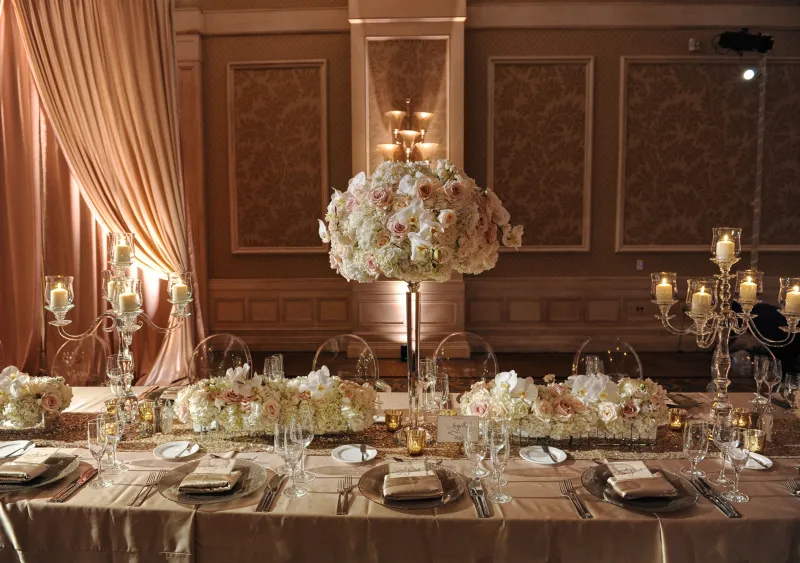
Photo: elegant low floral centerpiece on dinner table place setting candlelight, via apis.xogrp.com
The Number That Startles
A host receives a proposal for a dinner for sixty. The line item reads: eighteen centerpieces, six hundred dollars each. The host does the arithmetic, pictures a vase of garden roses, and concludes that something has gone wrong.
Nothing has gone wrong. What has happened is that the host has been handed a number without a story, and a number without a story always looks like an overcharge. Price transparency is not a concession in a luxury service; it is part of the service. So here is the story, told plainly, using a representative arrangement: a low, wide centerpiece of about twenty inches in diameter, built for a seated dinner, designed to be viewed from all sides and to hold for eight hours.
Line One: Stems, and the Ones That Never Make It
Botanicals for this piece cost the studio approximately $120. That figure already includes the waste, which is the part clients rarely consider. A studio ordering for a Saturday event takes delivery on Thursday. Some portion of that delivery will not be usable: stems that arrived broken, blooms that opened too far in transit, stock that does not match the sample approved six weeks earlier. A well-run studio plans for a loss rate of fifteen to twenty-five percent on perishable material, and that loss is built into the cost of the flowers that survive.
Seasonality moves this line more than anything else. A centerpiece built on peonies in June and one built on the same footprint in February are not the same product, and no honest designer will quote them as though they are.
Line Two: The Vessel and the Mechanics
$45. A production vessel for a large centerpiece — heavy enough to resist a leaning branch, wide enough to hold the water volume required — runs between thirty-five and seventy dollars at wholesale, and the client keeps it. Add the interior mechanics: netting, wire, moss, tape, a pin frog where the design calls for one. These are inexpensive individually and add up across eighteen pieces.
Line Three: Labor, Hour by Hour
This is the line that surprises people, and it is the largest single cost.
- Design and build: 2.25 hours at $60 per hour — $135. A centerpiece of this scale is not assembled in twenty minutes. Placement is deliberate; each stem is cut, conditioned, and set at an angle chosen rather than found.
- Processing and conditioning: 1.5 hours at $34 per hour — $51. This is the unbilled work clients imagine happens by itself. Stems are stripped, cut on a diagonal, hydrated, and left to drink for a minimum of four hours — often overnight — before they are placed. The arrangement that lasts eight hours on a table was made possible twelve hours before the first guest arrived.
Direct labor total: $186.
Line Four: Delivery, Installation, Retrieval
$40 allocated. The piece must travel in a temperature-controlled vehicle, be carried in level, be set on the table without being rotated out of composition, and — if the client has requested it — be retrieved the following morning. Split across a full event order, delivery and installation frequently exceed what a client would guess.
Line Five: Studio Overhead
$105 allocated. The client is not buying square footage, but they are using it. Studio rent, refrigeration, insurance, software, tools, sample materials, marketing, and the administrative hours spent on contracts and floor plans all sit behind the arrangement. Across a well-run studio this allocation lands between fifteen and twenty percent of the retail price. It is not padding; it is the reason the studio still exists in three years.
The Ledger, Closed
| Line | Cost |
|---|---|
| Botanicals, including waste | $120 |
| Vessel and mechanics | $45 |
| Direct labor (design and conditioning) | $186 |
| Delivery, installation, retrieval | $40 |
| Overhead allocation | $105 |
| Total cost | $496 |
| Gross margin | $104 (17%) |
Seventeen percent is not a windfall. It is what allows a studio to replace its refrigeration when it fails in July, to pay a designer a wage that keeps them in the trade, and to absorb the event that gets cancelled after the flowers have already been delivered.
What the Host Was Actually Imagining
When a client hears six hundred dollars, they are often picturing the flowers alone — and comparing that figure to a grocery store bouquet that contains perhaps a third of the stem count and none of the structure. The comparison is not dishonest; it is simply incomplete, in the way that comparing the price of a suit to the price of its fabric would be incomplete.
A large centerpiece for a seated dinner contains between forty and seventy stems, arranged so that no angle is empty and no stem is visible in support of another. It is built to be looked at from every seat at the table, to hold its form as the room warms, and to be carried out at midnight without shedding.
Why Transparency Is the Luxury
There is a version of this trade in which the client is quoted a number, accepts it, and never learns what it bought. That version is common. It also produces the suspicion that follows the industry — the sense that flowers are marked up arbitrarily and that the host is being indulged rather than served.
The alternative is an itemized proposal that separates flowers, vessel, labor, and delivery, and states the loss rate openly. Few studios offer this, in part because it invites negotiation. We offer it because a client who understands the ledger becomes a client who can make real decisions: where to spend, where to simplify, and which elements of the evening are worth the money.
A six-hundred-dollar centerpiece is not expensive because flowers are expensive. It is expensive because it is nine hours of skilled work compressed into an object that will look effortless for exactly one evening. Understanding that is not a justification. It is simply the truth, told early.