The Ephemeral Garden: Why Design-Forward Hosts Are Leasing Botanicals for Their Most Memorable Events
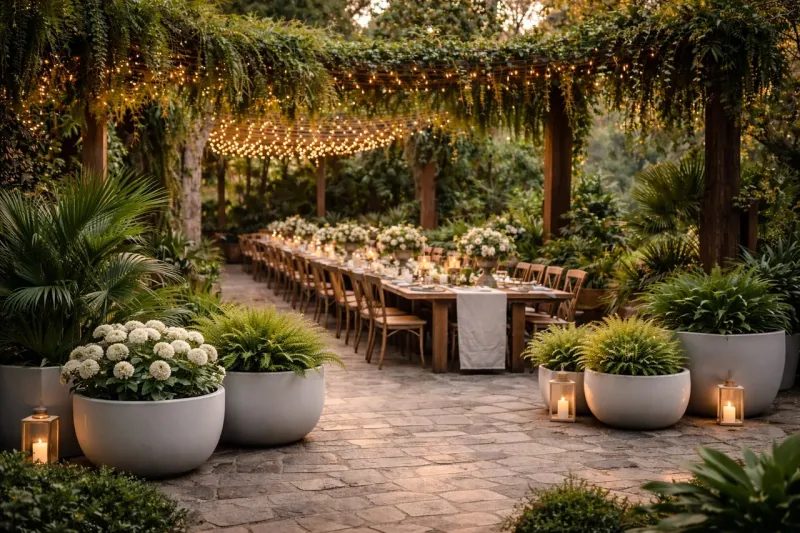
Photo: luxury event botanical installation living plants elegant dinner party, via cdn11.bigcommerce.com
There is a particular kind of confidence required to invest meaningfully in something that will not remain. A table set with rare orchids, a ceremony arch woven through with living moss and trailing jasmine, a cocktail-hour installation that stops guests mid-conversation — these are gestures of hospitality at their most intentional. And yet, for decades, the conversation around event floristry in the United States has been framed almost entirely around permanence: cut stems arranged, displayed, and ultimately discarded within days of their debut.
That conversation is shifting. Across the country, a growing cohort of design-conscious hosts — from corporate event planners in Chicago to wedding clients in the Hudson Valley — are turning to high-end floral leasing programs that offer something traditional floristry rarely can: botanical installations of genuine artistic ambition, returned and replanted once the celebration concludes.
From Centerpiece to Installation: Redefining What Event Floristry Can Be
The distinction between a floral arrangement and a botanical installation may seem semantic, but it carries significant design implications. A leased botanical program typically draws from living specimens — potted trees, rooted topiaries, established ferns, specimen succulents, and flowering shrubs — rather than cut material alone. This shift in medium changes everything about the visual register of an event.
Where cut flowers communicate abundance and momentary splendor, living botanicals suggest permanence, intention, and a certain rootedness that resonates deeply with guests who have grown accustomed to discerning the difference between decoration and design. A reception hall anchored by a pair of six-foot olive trees in aged terracotta urns does not merely look beautiful; it feels considered. It suggests that the host understands space, scale, and the quiet authority of the natural world.
Several design studios working in major US markets have begun building dedicated leasing inventories specifically for this purpose — curating collections of mature specimens that can be staged, styled, and returned to their growing environments after each event. The result is a library of living design objects available for temporary deployment, not unlike the art rental programs that have long served corporate interiors and hospitality spaces.
The Sustainability Argument, Honestly Examined
It would be disingenuous to discuss floral leasing without acknowledging the environmental context that has accelerated its appeal. The conventional cut-flower industry, while beautiful in its output, carries a substantial ecological footprint. The majority of fresh flowers sold in the United States are imported — predominantly from Colombia and Ecuador — and arrive via refrigerated air freight before moving through a cold chain that ends, in most cases, with disposal within a week.
Leased botanical programs interrupt this cycle in meaningful ways. Living specimens travel once to an event and return to a nursery or growing facility, where they are tended, repotted as needed, and made available for future use. A well-maintained specimen tree may serve dozens of events over the course of several years. The carbon calculus is imperfect — transportation and climate-controlled storage carry their own costs — but the overall reduction in single-use organic waste is difficult to dispute.
For hosts whose values include environmental stewardship, the leasing model offers something increasingly rare in luxury event design: an option that is both visually exceptional and philosophically defensible. This alignment of aesthetics and ethics has proven particularly resonant with clients in their thirties and forties who are accustomed to making purchasing decisions that reflect their broader worldview.
The Economics of the Borrowed Garden
For those accustomed to receiving floristry invoices, the cost structure of a leased botanical program requires some reorientation. The initial investment for a high-quality leased installation — particularly one featuring mature specimen plants — is often comparable to, or modestly higher than, a traditional luxury floristry package of similar visual scale. What changes is the value equation.
Cut flowers are consumed entirely by the event. Leased botanicals, by contrast, represent a shared asset whose cost is distributed across multiple engagements. From the client's perspective, this means access to design elements — a grove of white-flowering camellias, a collection of sculptural agaves, a series of espaliered fruit trees — that would be prohibitively expensive to source and discard for a single occasion.
There is also the question of what is being purchased. Traditional floristry sells product. Leased botanical design sells experience — the specific sensation of moving through a space that has been transformed by living, breathing plant material of genuine horticultural distinction. For a growing number of hosts, that distinction justifies the investment entirely.
Designing the Temporary with Permanent Intention
The designers working most fluently within this model approach each leased installation with the same rigor they would bring to a permanent interior commission. Plant selection is guided not only by visual criteria but by the conditions of the venue — light levels, ceiling height, floor surface, ambient temperature — and by the narrative the host wishes to establish.
A winter gala in a Manhattan loft might be anchored by a forest of bare-branched birch specimens underplanted with white hellebores and silvery lamb's ear, the entire composition evoking a frost-touched woodland that exists only for the duration of the evening. A spring wedding in a restored Virginia estate might feature a progression of potted wisteria and climbing roses trained onto portable trellises, creating a series of garden rooms within a single ballroom.
In each case, the design team works backward from the guest experience — what will someone feel when they enter this space? What will they remember when they leave? — and forward from the practical constraints of transportation, installation time, and safe return. It is a discipline that rewards both botanical knowledge and spatial imagination in equal measure.
The Gallery Evening as Model
Perhaps the most useful frame for understanding the appeal of leased botanical design is the gallery opening. When a collector hosts an exhibition in their home, they do not expect to keep every work on view. The experience — the curation, the conversation, the visual encounter — is the point. The art departs; the memory remains.
Leased botanical installations operate on precisely this logic. The garden is borrowed, but the impression it leaves is entirely one's own. For design-conscious hosts who understand that the most enduring luxury is not possession but experience, the ephemeral garden represents not a compromise but an evolution — a more sophisticated understanding of what it means to create a space worthy of the moments that unfold within it.
At Tierra Floral Design, we believe that botanical artistry need not be measured by its longevity. Some of the most profound design experiences are, by nature, temporary. What matters is that they are composed with care, executed with precision, and offered with the full understanding that beauty — however briefly it resides — has the power to transform the way people feel, connect, and remember.