The Art of Letting Go: Why Luxury Interiors Are Embracing Flowers That Will Not Last
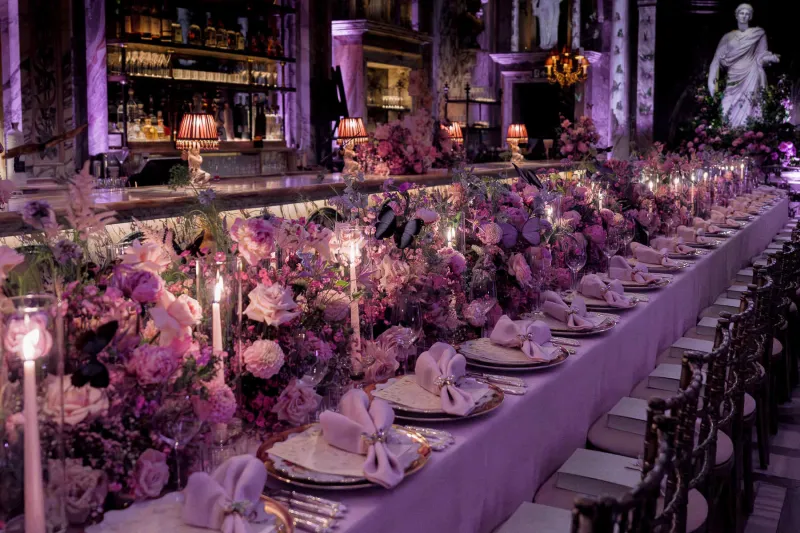
Photo: luxury ephemeral fresh floral installation event design elegant dinner party botanical, via bloominghaus.com
For decades, the aspirational interior was defined by its durability. Marble that endures, upholstery that resists, arrangements that photograph the same on Tuesday as they did on Saturday. Permanence was the ultimate status signal—evidence that beauty had been acquired, maintained, and secured against time's inevitable erosion.
Something has shifted. In the studios of the country's most sought-after interior designers and across the event spaces of New York, Los Angeles, Chicago, and beyond, the conversation has turned decisively toward a different ideal: the beauty that is precious precisely because it cannot be kept.
The ephemeral floral installation has arrived as a genuine luxury proposition—and its rise reveals a great deal about where sophisticated design consciousness is headed.
The Counterintuitive Logic of Impermanence
At first glance, the appeal of a floral installation that will wilt within days seems difficult to justify at a premium price point. Why commission an elaborate fresh botanical environment—complete with cascading garden roses, moss-covered armatures, and hand-selected seasonal blooms—for an event or interior moment that will exist for only 48 to 72 hours?
The answer, articulated by designers and their clients alike, is that the transience is not a limitation. It is the point.
There is an inherent exclusivity in an experience that cannot be repeated, archived, or reproduced with fidelity. The guests who moved through a flower-draped dining room on a Saturday evening in May were present for something that no photograph will fully capture and that no one who was absent will ever truly access. That irreproducibility—so rare in an era of infinite digital replication—has become a form of genuine luxury.
Mindfulness and the Living Installation
The philosophical underpinning of this trend extends well beyond exclusivity. Many of the design-conscious consumers driving demand for ephemeral botanical experiences are also deeply engaged with mindfulness practices and the broader cultural conversation around intentional living.
Fresh floral installations demand presence. A room filled with living flowers changes hour by hour—a blossom opens, a petal drops, a fragrance deepens as the evening warms. These are not static backdrops; they are active participants in the experience of a space. For clients accustomed to interiors where every element has been optimized for longevity and control, this aliveness can feel quietly radical.
Several high-profile designers working in the residential luxury market have described the shift in terms that echo mindfulness philosophy: their clients are no longer seeking spaces that resist time, but spaces that honor it. The wilting flower is not a failure—it is a reminder that beauty is not diminished by its brevity.
A Rejection of the Curated Feed
It would be incomplete to discuss this trend without acknowledging its relationship to the saturation of social media aesthetics in design culture. For much of the past decade, the aspirational interior has been shaped—consciously or not—by the demands of the image: symmetrical, perfectly lit, endlessly reproducible, and optimized for maximum visual impact on a small screen.
Ephemeral botanical design is, in part, a sophisticated recoil from that pressure. A fresh installation of garden-harvested sweet peas and trailing jasmine, arranged loosely over a dining table set for twenty, will not look the same in every photograph. It resists the flattening effect of the curated image. It rewards the person who is physically present—who can smell the jasmine, notice the way afternoon light moves through the petals, observe the subtle changes that occur over the course of an evening.
For a certain stratum of design-conscious consumers, this resistance to easy reproduction is itself a statement of values. It is a way of insisting that some experiences remain stubbornly, beautifully analog.
The Event as Botanical Theater
The trend is perhaps most visible—and most dramatically expressed—in the realm of private event design. At the level of the truly bespoke gathering, the floral environment is no longer conceived as a backdrop. It is the event's central character.
Imagine a dinner where the ceiling is draped in fresh wisteria and white ranunculus, where each table is anchored by an overflowing urn of garden-cut dahlias and trailing smilax, and where the entire installation has been designed with the understanding that it will be composted by morning. The investment is considerable. The lifespan is measured in hours. And yet, for both the host and the guests, the memory of that evening—of being inside something so alive and so fleeting—carries a weight that no permanent décor element could replicate.
At Tierra Floral Design, we approach these commissions with the seriousness they deserve. The design of an ephemeral installation requires not less planning than a permanent one, but more: more attention to the arc of the experience, more consideration of how the flowers will evolve over the course of an event, and more intentionality about the sourcing and environmental impact of materials that will have so brief a life in the space.
Sourcing, Sustainability, and the Ethics of the Fleeting
A legitimate question surrounds the sustainability of this approach. If fresh installations are composed and composted within days, does the environmental cost outweigh the experiential benefit?
The most thoughtful designers working in this space are addressing this directly. Locally sourced, seasonally appropriate botanicals—procured from American flower farms and regional growers rather than flown in from overseas—significantly reduce the carbon footprint of even the most elaborate installation. The composting of organic material returns nutrients to the soil. And the deliberate, mindful use of flowers in concentrated, meaningful moments arguably represents a more considered relationship with botanical material than the constant low-level consumption of mass-market arrangements that wilt unnoticed on a kitchen counter.
Impermanence, handled with intention, can be among the most responsible forms of luxury.
The Brief Life of Something Beautiful
There is an old Japanese aesthetic concept—mono no aware, the bittersweet awareness of impermanence—that has long informed Japanese art, garden design, and the ritual appreciation of cherry blossoms. American luxury design, in its embrace of the ephemeral botanical installation, is arriving at something analogous through its own cultural path.
The flowers that bloom for a single evening, that fill a room with fragrance and then quietly fade, ask something of us that permanent design elements do not: they ask us to be present, to pay attention, and to find in transience not loss, but a particular and irreplaceable form of beauty.
That, in the end, may be the most meaningful luxury of all.