Petals as Identity: What Your Botanical Aesthetic Reveals About Who You Are
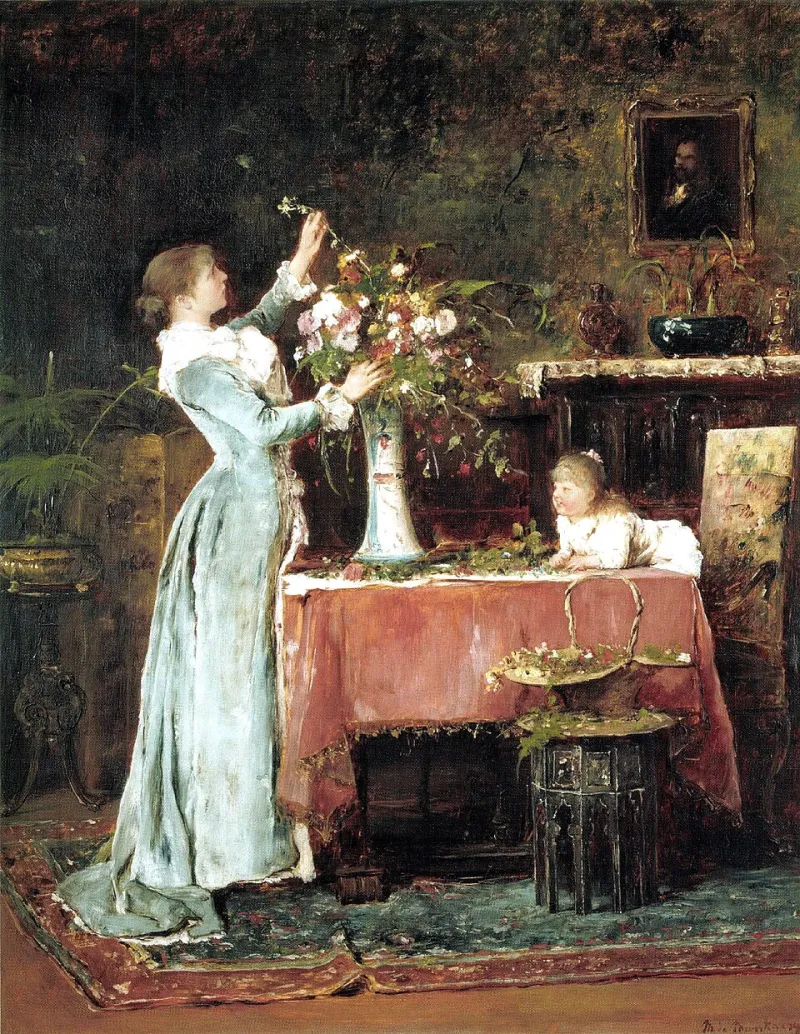
Photo: Mihály Munkácsy, Public domain, via Wikimedia Commons
There is a longstanding tradition in botanical culture of assigning meaning to flowers. The Victorian practice of floriography—communicating emotions through carefully chosen blooms—has never truly disappeared. It has simply evolved. In 2024, the language of flowers is no longer confined to secret courtship notes or funeral arrangements. It has expanded into something far more nuanced: a daily, ongoing declaration of personal identity expressed through the botanical choices woven into American homes, events, and lived environments.
The question is no longer merely which flowers you prefer. It is what the totality of your botanical decisions—the vessels you select, the color stories you favor, the degree of wildness or restraint you permit—reveals about your values, your emotional architecture, and the life you are actively designing.
The Psychology Behind Plant Preferences
Research in environmental psychology consistently affirms that individuals are drawn to natural elements that mirror or complement their internal states. A person navigating a high-stimulus professional life may gravitate toward the quiet dignity of a single white orchid, finding in its stillness a form of visual respite. Conversely, someone who craves connection and sensory richness may fill every surface with layered arrangements of garden roses, trailing vines, and seasonal wildflowers.
Psychologist and design researcher Dr. Sally Augustin has noted that our aesthetic preferences are rarely arbitrary—they are shaped by temperament, memory, and aspiration. Applied to botanical design, this means your instinct to reach for a bundle of dried pampas grass rather than a fresh peony arrangement is not simply a matter of trend-following. It reflects something authentic about how you process beauty, impermanence, and domesticity.
Floral designers working across the United States are increasingly attuned to this dimension of their craft. When a client describes wanting something that feels "alive but not chaotic" or "structured but not cold," they are not merely describing an arrangement. They are articulating a self-concept.
Maximalism and the Botanical Statement
For the maximalist, botanical design is theater. Arrangements spill generously from oversized vessels, mixing unexpected textures—waxy anthuriums alongside feathery astilbe, glossy magnolia leaves paired with frothy white anemones. Color is deployed with confidence: saturated jewel tones, clashing complements, and the kind of abundance that makes a room feel inhabited by someone who does not fear excess.
In American interiors, this aesthetic has found particular expression in spaces that celebrate eclecticism—Brooklyn brownstones layered with global textiles, New Orleans homes where history and ornament coexist without apology, California residences where the boundary between indoor and outdoor dissolves entirely. For these homeowners, botanical maximalism is an extension of a broader philosophy: that more, done with intention, is never too much.
The maximalist botanical identity tends to signal a person who is comfortable with complexity, who finds joy in curation, and who views their home as an evolving, living gallery rather than a static backdrop.
Minimalism and the Considered Stem
At the opposite end of the spectrum, the minimalist botanical approach communicates with equal eloquence—it simply speaks in a quieter register. A single branch of cherry blossom in a narrow ceramic cylinder. Three stems of white tulips, unadorned, in a clear glass vessel. A low, flat arrangement of succulents in a concrete tray.
This restraint is frequently misread as indifference, but it is anything but. The minimalist botanical aesthetic demands a heightened sensitivity to form, negative space, and the inherent sculptural quality of plant material. It is the design philosophy of someone who believes that one perfectly chosen element outperforms a room full of noise.
This sensibility resonates strongly in the Pacific Northwest and among consumers drawn to Scandinavian and Japanese design traditions—aesthetics that have deeply influenced American interiors over the past decade. For these individuals, botanical choices are an exercise in editing, in the discipline of knowing what to leave out.
Bohemian Botanicals: The Romantic Naturalist
Between these poles lives the bohemian botanical identity, perhaps the most romantically inclined of the major design philosophies. The bohemian approach embraces imperfection and organic asymmetry. Dried flowers hang from exposed beams. Terracotta pots crowd windowsills. Arrangements incorporate foraged branches, seed pods, and blooms that are just past their peak—deliberately, beautifully impermanent.
This aesthetic carries a strong emotional undercurrent. It is less concerned with precision than with atmosphere, less invested in formality than in feeling. The bohemian botanical home is a place that appears to have grown organically, accumulating layers of meaning over time rather than being assembled in a single, decisive act of decoration.
For consumers who identify with this approach, botanical choices often reflect a broader set of values: sustainability, handcraft, a resistance to the overly polished, and a deep appreciation for the beauty inherent in natural processes—including decay and transformation.
The Modern Botanical: Architecture Meets Nature
The contemporary modernist botanical aesthetic represents perhaps the most architecturally informed approach to floral design. Here, flowers and plants are selected for their structural qualities as much as their color or fragrance. Bird of paradise, monstera, calla lilies, and sculptural cacti populate these spaces—chosen for their geometric precision and their ability to hold their own against clean lines and unadorned surfaces.
This design identity is particularly prevalent among consumers who inhabit mid-century modern homes, loft-style apartments, and newly constructed spaces with high ceilings and expansive glass. For these individuals, botanical elements serve as the organic counterweight to architectural rigor—a reminder that even the most considered human-made environment benefits from the presence of something genuinely alive.
Decoding Your Own Botanical Language
Understanding what your botanical preferences reveal is not an exercise in self-analysis for its own sake. It is a practical tool for making more intentional design decisions. When you recognize that your instinct toward wildflower arrangements reflects a desire for spontaneity in an otherwise structured life, you can lean into that instinct with greater confidence—and greater coherence across your entire living environment.
Begin by auditing your existing botanical choices. What vessels do you reach for repeatedly? Which color stories appear consistently? Do you tend toward the ephemeral freshness of cut flowers or the enduring presence of living plants and dried botanicals? These patterns are not accidents. They are a design vocabulary that is already yours.
At Tierra Floral Design, we believe that the most sophisticated botanical environments are those that feel genuinely expressive—spaces where every arrangement, every planted vessel, and every foraged branch contributes to a coherent visual identity that belongs unmistakably to the person who inhabits it.
In 2024, botanical design is no longer a finishing touch. It is a foundational act of self-authorship. And the most beautiful spaces are always, in some essential way, portraits of the people who created them.